
Paracelsus, the father of toxicology and a medical pioneer from the Renaissance, said “Sola dosis facit venenum” which is translated into “Only the dose makes the poison”. This is not true in all cases (like for carcinogenic substances), but it does link to different ways our bodies can take care of certain quantities of toxins. The same applies to ecosystems, which can be resilient to a limited amount of contaminants. For example, if you throw a banana peel into a forest, it will be easily degraded and its molecules will be incorporated into the ecosystem. This is because a lot of ecosystems contain microorganisms such as bacteria, yeast and fungi with the ability to degrade different organic substances, or to deal with inorganic substances such as heavy metals.
However, the same would not happen if you would throw thousands of banana peels into a forest. The degrading capacities of the ecosystem would not be enough for this amount of waste, which would interfere with and harm the ecosystem. Sadly, human activity tends to generate large amounts of waste that ends up contaminating ecosystems. Whether contamination occurs due to accidental, mismanagement, or intentional reasons, humans can (and should) intervene in the ecosystem to remove these pollutants. There are different ways to do this, and when microorganisms are used, the process is called bioremediation.
Bioremediation
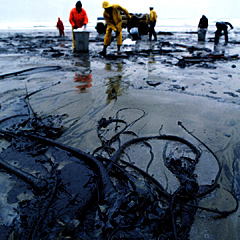
Bioremediation can be defined as the use of microorganisms to clean environmental pollutants. These microorganisms can be naturally present at the site to be cleaned, or they can be deliberately added. Bioremediation was tested in the Exxon Valdez oil spill, which happened in Alaska in 1989. Different indigenous bacterial species were used to degrade the oil into less harmful substances that could be assimilated by the ecosystem. To achieve this, fertilizers and surfactants were added to the site to facilitate the bacterial growth and the degradation of the oil, respectively.
Different bioremediation techniques exist for different locations (such as underground or the ocean) and different kinds of pollutants. Persistent organic pollutants are complex molecules that only a few organisms can degrade, so that their disappearance from the ecosystem can take a long time. Examples of these kinds of organic wastes are fossil fuels and their derivatives, or synthetic dyes used in industry. Among inorganic pollutants the most important ones are heavy metals, like zinc, cadmium or lead.
How humans do bioremediation
There are two main approaches by which bioremediation can be carried out. If the process takes place directly in the contaminated site, the term in-situ bioremediation is used. In contrast, ex-situ bioremediation is the process by which some part of the contaminated area is removed and taken into some other place for further processing.
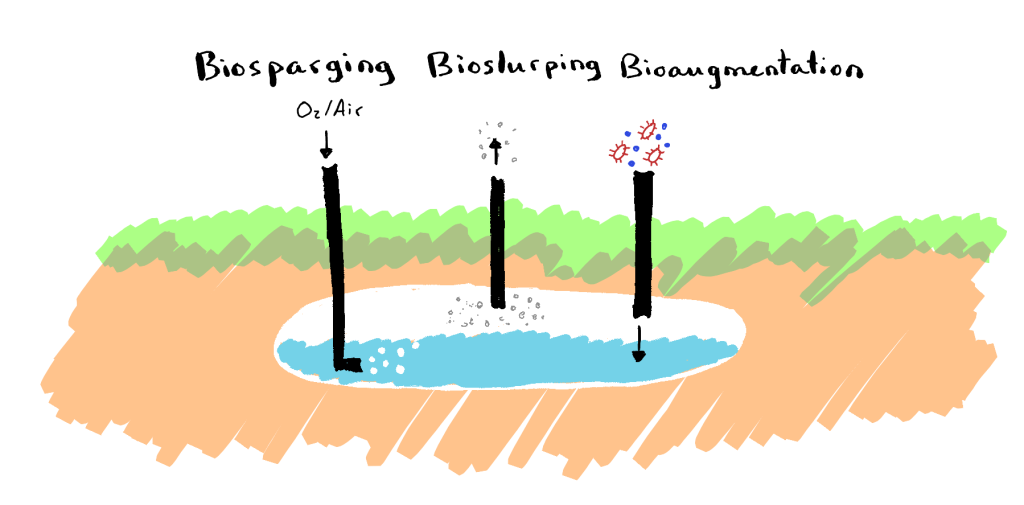
When possible, in-situ bioremediation is preferred because it is cheaper and less invasive. There are different strategies that can be followed. Bioventing and biosparging consist of the introduction of air or oxygen into soil or groundwater, respectively. The oxygen will enhance the metabolic capacity of the indigenous microbes to degrade organic pollutants. Bioslurping follows the same principle but using vacuum to extract volatile contaminants. Bioaugmentation refers to the introduction of external microbes or enzymes to assist the indigenous microbial community. Not all pollutants can be taken care of this way, and high concentrations of heavy metals or other contaminants can be too toxic for microbial action alone to have a direct impact.
In these cases, ex-situ bioremediation might be used instead. Most of these techniques are based on the removal of contaminated soil and its mixing to ensure aerobic conditions that stimulate microbial activity. Depending on the scale and the pollutants different strategies can be used such as biopiles, windrows, landfarming or composting. For difficult cases, bioreactors can be used to generate the optimal conditions for microorganisms (indigenous or not) to act against the pollutant. Unlike other techniques, bioreactors require specialized equipment and additional resources, making them unsuitable for all cases.
How microbes do bioremediation
All the previous methods are designed to bring microorganisms into contact with different pollutants. Once this happens, there are different ways in which the microorganisms can take care of the contaminants. In the case of organic pollutants, the usual way is to metabolize them, converting them into non-toxic substances that the organism can use to grow. Different microorganisms have different metabolic capacities, and that is why sometimes it is necessary to bioaugment the contaminated site with external microbes or enzymes.
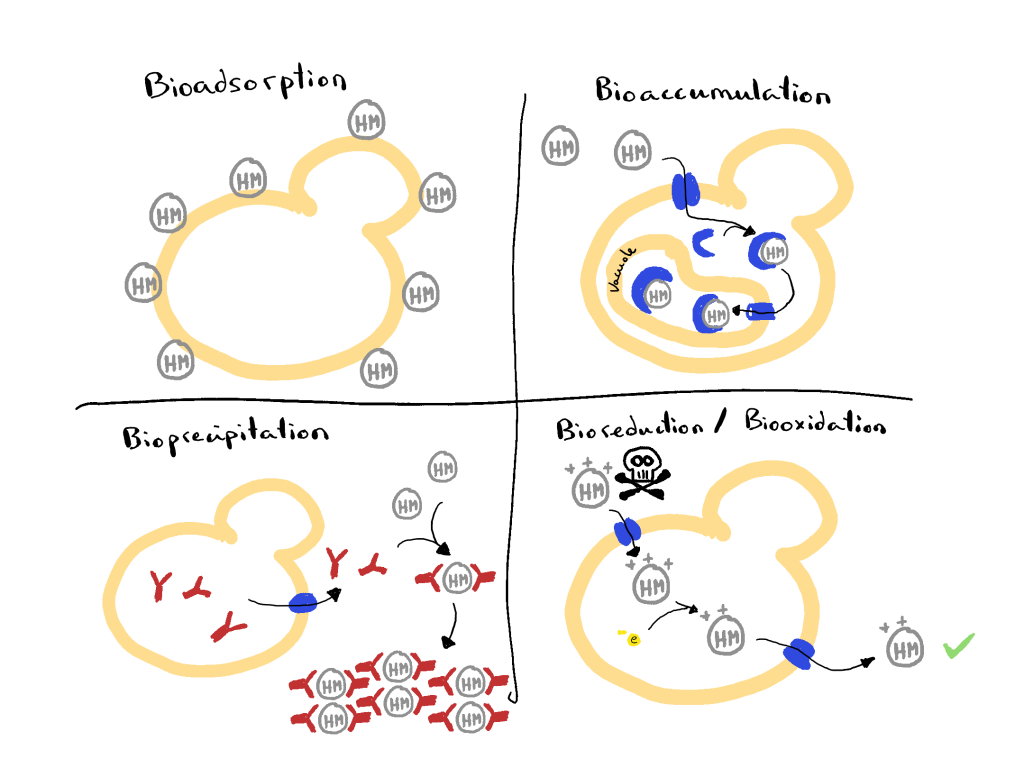
In the case of heavy metals, they cannot be converted into other elements because microbes are not alchemists. However, they have a wide range of techniques to deal with them. Bioadsorption or biosorption refers to the binding of heavy metals or other pollutants (such as organic azo dyes) to the surface of the cells, thanks to chemical interactions. The advantage of this mechanism is that it will still work even if the cell is dead. Bioaccumulation happens when the cells transport the metal atoms inside storage organelles where they interact with special proteins that prevent them from having toxic effects inside the cells. Another strategy that can happen in liquid environments is for the cells to secrete molecules that will interact with external heavy metals and lead to their precipitation. Finally, although heavy metals cannot be transformed into other elements, their electron composition can be altered to reduce their toxic effects, a process called bioreduction or biooxidation, depending on whether the metals gain or lose electrons, respectively.
Using yeasts in bioremediation
While many people might associate yeasts primarily with beer and bread, yeasts are everywhere in nature. Yeasts inhabit diverse environments and have evolved the ability to degrade a wide range of substances. In 2018, a Portuguese group of researchers was able to isolate eight different yeasts species that were able to degrade complex synthetic dyes used in textile industry. All these yeasts were obtained from the same ecological site, an area of forested wetland. This example shows how the microbial communities of natural ecosystems include yeasts among the microorganisms able to aid in bioremediation.
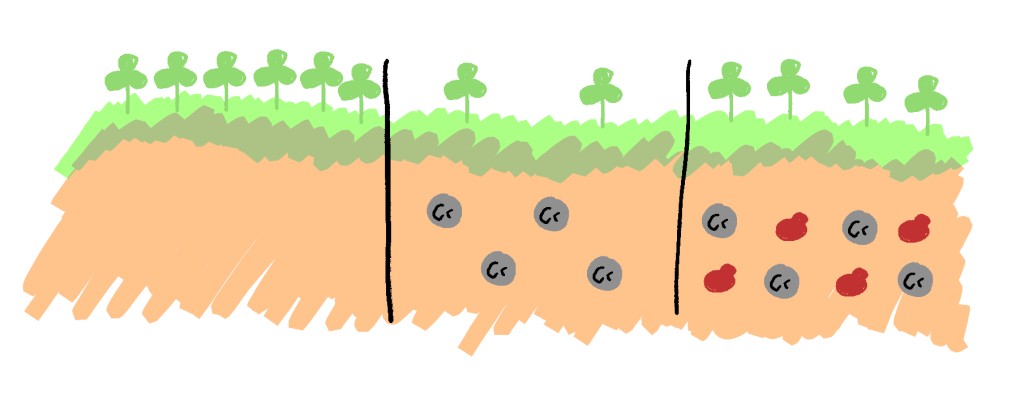
Nevertheless, certain yeast species have gained a special place in research on environmental biotechnology due to their degrading abilities. This is the case of Candida tropicalis, a versatile yeast found in many habitats, which is able to use oil as a source for growth. Candida tropicalis is able to convert the hydrocarbons present in petroleum, and assimilate them as useful lipids for the cell. In a 2013 study, a group of Chinese researchers was able to isolate a Candida tropicalis strain from petroleum contaminated soil, and they showed that using this yeast for bioaugmentation increased the natural ability of the contaminated soil to degrade the petroleum molecules. But the possibilities of this yeast expand beyond degrading oil. In a study also from 2013, a group of Moroccan researchers showed that both alive and dead Candida tropicalis cells were able to bioremediate soil contaminated with the heavy metal chromium. This metal impacts plant growth, so they used clover as an indicator of chromium removal. Whenever the yeast was added in addition to chromium, more clover seeds germinated than if chromium was added alone.
However, a major drawback of Candida tropicalis is that it is a known human pathogen. This poses an issue when dumping large amounts of this yeast in areas that might affect human populations. Luckily for this yeast, its usefulness is not limited to its ability to dispose of pollutants, since it can also be used to produce molecules that can help bioremediation. Since this yeast can feed on oils, it needs a way to make these oils more available for consumption, which is a problem because oil does not mix with water, so it tends to form large clumps. To break these clumps, Candida tropicalis is able to produce biosurfactants, which behave like detergents and allow oil to be more easily mixed with water. In 2021, a Brazilian research group showed that a biosurfactant produced by Candida tropicalis could be used to accelerate bioremediation of petroleum contaminated coasts, by making the petroleum molecules more available to the indigenous microorganisms.
There have also been efforts in using genetic engineering to increase the bioremediation capabilities of yeasts. In a patent filed by the MIT in 2018, three different strategies against heavy metals were described. The first strategy described how to engineer yeasts to produce proteins in their surface that are able to bind heavy metals and sequester them from the medium. In the second strategy, the yeast is engineered to produce transport proteins that will bring the heavy metals to an internal cellular compartment (vacuole), where there will be proteins able to sequester the metals. The last strategy consists in engineering yeasts that accumulate cysteine, an amino acid containing sulfur that is able to bind to heavy metals and sequester them. These strategies aim to increase the bioadsorption and bioaccumulation capacities of yeast cells.
Conclusion written by me
Bioremediation techniques have been developing for many years, and a variety of approaches have been put forward for different situations. Most of them involve increasing the natural ability of the microbial community in ecological sites to degrade pollutants. However, in some challenging cases external microbial help is needed and in most of these cases bacteria and mold fungi seem to have been major players. Some researchers argue that yeasts could be more effective than bacteria or fungi in certain bioremediation applications. Even though there is a patent out there, and there is plenty of research on the bioremediation capacities of yeasts, there is a lack of information about whether yeasts are actually used in bioremediation projects. Time will tell if yeasts take over this area of environmental technology. However, while finding the best tools for bioremediation is important, preventing pollution in the first place should be our priority.
Sources
Review on bioremediation techniques with focus on the use of fungi and bacteria: Natesan Thirumalaivasan, Lalitha Gnanasekaran, Suresh Kumar, Rajesh Durvasulu, Thanigaivel Sundaram, Saravanan Rajendran, Senthilkumar Nangan and Kuppusamy Kanagaraj (2024) Utilization of fungal and bacterial bioremediation techniques for the treatment of toxic waste and biowaste. Frontiers in Materials
Review on the ability of yeasts of the genus Candida to bioremediate different pollutants: Samriti Rana, Shristi Handa, Yadu Aggarwal, Sanjeev Puri, Mary Chatterjee (2023) Role of Candida in the bioremediation of pollutants: a review Letters in Applied Microbiology
Book chapter on the use of yeasts to bioremediate heavy metals: Wifak Bahafid, Nezha Tahri Joutey, Meryem Asri, Hanane Sayel, Nabil Tirry and Naïma El Ghachtouli (2017) Yeast Biomass: An Alternative for Bioremediation of Heavy Metals. Yeast – Industrial Applications
Article on the use of Candida tropicalis to clean petroleum-contaminated soil: Mei-Ying Fan, Rui-Jie Xie & Gang Qin (2013) Bioremediation of petroleum-contaminated soil by a combined system of biostimulation–bioaugmentation with yeast Environmental Technology
Review on yeast biosorption mechanisms for synthetic dyes: M. Danouche , H. El Arroussi , W. Bahafid & N. El Ghachtouli (2021) An overview of the biosorption mechanism for the bioremediation of synthetic dyes using yeast cells, Environmental Technology Reviews
Article on yeasts with bioremediation potential obtained from flooded forest: Ana C. Sampaio, Rui M. F. Bezerra & Albino A. Dias (2018) Mediterranean forested wetlands are yeast hotspots for bioremediation: a case study using azo dyes. Nature scientific reports
Patent with genetic engineering strategies to enhance yeast capacity for heavy metal bioremediation: George Le-le Sun, Angela M. Belcher (2018) Engineered yeast as a method for bioremediation. Patent nr. WO2018144807A2
 English
 Spanish