
The natural origin of baker’s yeast has been traced back to ancient East Asian forests. At some point in the past, these yeasts living in the wild came in contact with humans, a meeting that would change the world forever. Baker’s yeast became prominent in fermented food and beverages, either through spontaneous colonization or by the conscientious acts of humans. Human civilizations were profoundly impacted, most importantly through the control of alcohol production, something that has even been felt through changes in our DNA. In return, baker’s yeast has also changed, mostly due to the direct action of humans and the conditions we created in the fermentation environments. This is the story of the domestication of baker’s yeast.
First steps in baker’s yeast domestication
Domestication can be generally defined as the human selection and breeding of wild species, producing genetically different variants adapted to man-made environments. Thus, domestication goes beyond cultivating crops or fencing animals to keep them from escaping. It is a way to influence the evolution of populations by increasing their usefulness to humans rather than their fitness in wild habitats. This way, traits such as larger fruits, friendlier dogs, or woollier sheep have been selected for thousands of years. This has also been the case with baker’s yeast, even if humans did not know they existed until a couple of centuries ago.
The first step in their domestication was the transfer of the yeast from the wild habitat to the human-associated habitat. This seems to have happened only once, since domesticated variants of baker’s yeast from around the world are more closely related to each other than wild baker’s yeasts from the original habitat of East Asian forests. While baker’s yeast populations are also found in wild habitats outside Asia, these might be later colonizers brought to that area by humans. After the first contact with humans, domesticated baker’s yeast differentiated quickly into two groups, one associated with solid fermentation (such as baijiu or sake) and another one with liquid fermentation (such as wine, beer, or traditional fermented dairy products from Mongolia and China). Since solid-state fermentation and fermented dairy products are restricted to East Asia, it is safe to assume that their common ancestor was also from this place, and only after a certain time, some variants traveled west. However, the wine and dairy groups seem to be the latest ones to have separated according to the results of the study, which defended the East Asian origin.

First mutations: Maltose utilization and flocculation
Besides a common genetic origin, all domesticated baker’s yeasts share certain mutations and traits that make them different from their wild cousins. The most important one is their improved ability to grow on maltose. Maltose is a molecule formed by two glucose molecules joined together, normally obtained from starch degradation. The majority of domesticated baker’s yeasts contain duplications of genes coding information for proteins associated with maltose metabolism, including a transporter and the enzyme maltase, which breaks maltose into two glucose molecules. These mutations are still found in baker’s yeast variants that are used in environments that do not have maltose, such as wine or dairy.
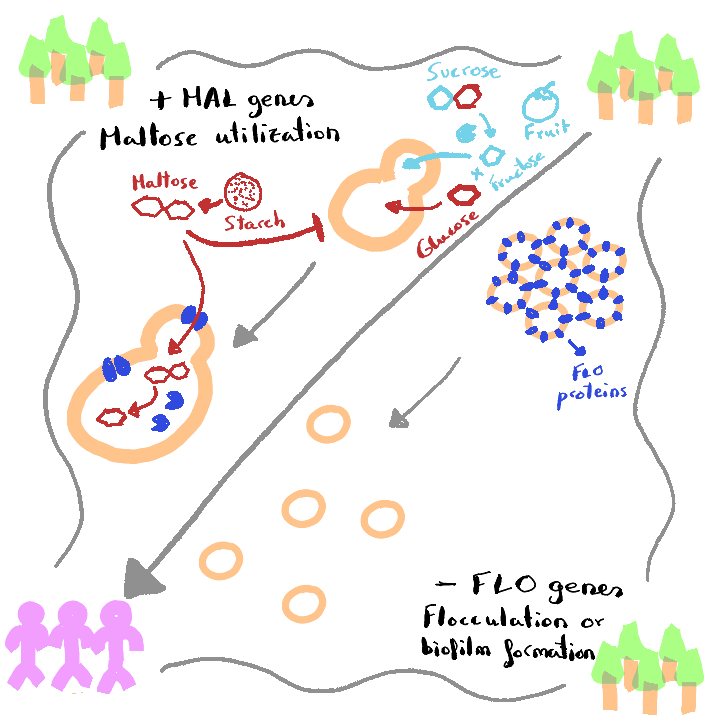
Another mutation found in almost all domesticated variants is the loss of flocculant proteins (FLO genes), which are responsible for keeping cells together after division, leading to the formation of biofilms. When cells are loose, they grow better and faster, being able to move around the media to reach more nutrients, but in the wild, these biofilms offer protection and increase survival. Since the fermentation conditions are safer for baker’s yeast, they do not need this extra protection, and they traded it off for increased growth, allowing them to outcompete other microbes present in the fermentation medium. Both of these adaptations show that human selection was changing baker’s yeast from the start, but more changes were yet to come as the yeast populations became specialized for specific products, such as wine or beer.
Specialized yeast cells in winemaking
After the first domestication event in East Asia, baker’s yeast expanded worldwide through human contact and a diversity of fermentation uses. The first archaeological evidence of wine dates back to 6000 BCE, and it was found in the Caucasus area of current Georgia. The oldest winery was found in neighboring Armenia, dating back to 4100 BCE. The grape variety domesticated in the Caucasus was contained in the area, and the widely used grape varieties nowadays come from a separate domestication event in the Near East. Yeast was more mobile, though, and it quickly dispersed through Mesopotamia and the Levant. From here, genetic studies have revealed that baker’s yeast moved further into Europe through two different routes. The first one was a Mediterranean one through the Italian Peninsula and the Iberian Peninsula into modern France through the Rhone Valley. The second followed the course of the Danube River.
During early domestication stages, different fermentation products might have shared yeast sources, like Mesopotamian beer produced from bread. With time, people used specific processes to inoculate fermentation products, such as previously fermented products or pure yeast cultures, after their development by Hansen at the end of the 19th century. For most of history, wine fermentation has been done spontaneously from yeast cells present in the skin of grapes, and pure cultures have only become widespread since the 70s when the technology behind active dry yeast had matured.
Wine mutations: Sulfite resistance
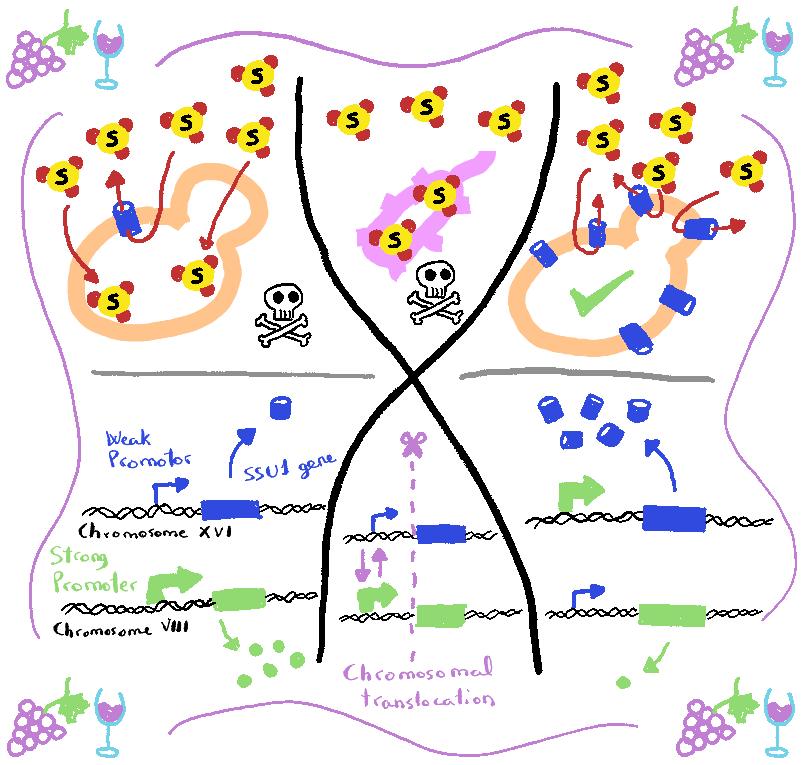
The association of yeast with grapes, the specific wine fermentation conditions, and the human selection of grape varieties based on the wine quality formed conditions through which yeasts evolved traits related to wine production. Some of these have been identified and studied. One of the most studied ones is the resistance to sulfites, sulfur-based chemical compounds that protect wine from oxidation and bacterial contamination. While sulfur might have already been used during the Roman Empire (Pliny the Elder mentions it, but it is not clear what it was used for), it was during the Middle Ages in Europe when it became widespread to ensure that the wine would remain of good quality during long transport routes. Sulfites are more toxic to bacteria than to baker’s yeast. All variants of baker’s yeast produce a protein in their membranes that can pump out sulfite compounds, keeping the concentrations inside the cell below the toxic levels. However, each protein can only pump so much sulfite, so higher sulfite concentrations can also be toxic for these yeasts.
After analyzing several wine strains, it has been observed that most contain a mutation that increases the number of sulfite pumps. This mutation has only been observed in yeasts associated with wine, indicating that it is a product of recent evolution. The gene affected by this mutation is called SSU1, and it contains the genetic information for the sulfite pump protein. The mutation occurred when a portion of the chromosome containing the SSU1 gene was replaced by a segment from another chromosome through a process known as chromosomal translocation. The exchanged region happened to be right next to SSU1, leading to a change in the promoter, the DNA sequence that controls its expression, which meant higher copies of the sulfite pump protein per yeast cell, allowing it to resist higher sulfite concentrations.
This is just one example of several mutations associated with winemaking. Others are related to copper resistance, high sugar concentrations, or low nitrogen concentrations. A very recent mutation is the one associated with Jerez wines, whose yeasts have recovered the ability to flocculate through mutations in the remaining FLO genes, leading to layers of yeasts floating in the barrels that grant cherry wines their particular properties.
Genetic evolution cases in beer production
In the same way yeasts associated with wine have accumulated mutations specific for wine production, the same has happened with beer-related yeasts. At some point in history, brewers started using good batches of beer to inoculate new batches, leading to a selective pressure for yeasts, and most importantly, separating this yeast lineage from the wine one. Genetic studies have identified two groups of beer yeasts, creatively called Beer 1 and Beer 2. The Beer 1 group originated first and spread across the world, branching into regional subgroups, while the Beer 2 group originated some years later, and its geographical differentiation seems less clear.
With reproductive isolation came genetic adaptation. Although Beer 1 and Beer 2 yeasts had different origins, they have developed similar characteristics (convergent evolution). Yeasts in both groups have an improved ability to consume maltotriose, better than wine yeasts. Maltotriose, like maltose, originates from the degradation of starch and contains three molecules of glucose. Yeasts associated with beer have accumulated mutations in a particular protein responsible for transporting sugars into the cell, allowing it to transport maltotriose easily, so the yeast can feed on it.
An important domestication event in beer yeasts is the origin of lager beers. These beers are produced at lower temperatures than the original ale beers. However, baker’s yeast (Saccharomyces cerevisiae) does not grow well at cold temperatures. At some point in the late Middle Ages, baker’s yeast fused with another species (Saccharomyces bayanus) in a process called interspecific hybridization. Saccharomyces bayanus was able to grow at cold temperatures, but lacked the specialized metabolism of the baker’s yeast to ferment beer efficiently in a satisfactory way. The new hybrid, called lager yeast (Saccharomyces pastorianus), could grow at cold temperatures and produce good quality beer. This is a fascinating example of how, especially in the microscopic world, the tree of life does not always branch out, but can branch in.
Conclusion written by me
Microorganisms like yeasts evolve much faster than humans due to their rapid reproduction. Additionally, they can acquire DNA from other species or form hybrids with them, making the construction of evolutionary trees in the microbial world particularly complex. These challenges are evident when studying the evolution of baker’s yeast since its first contact with humans. Some aspects are relatively clear: all domesticated yeast strains trace back to East Asian forests and have since diverged into subgroups specialized for various biotechnological uses. Specific mutations linked to wine or beer fermentation show how different environments have shaped their genetic evolution. However, the timeline of this diversification is still uncertain. Some studies suggest beer-specialized strains emerged in the Middle Ages, while others propose that the split between wine and Asian dairy strains occurred after beer specialization, implying that beer-related yeasts may have diversified before leaving East Asia. The precise evolutionary timeline remains a mystery, and further research is needed to fully understand how baker’s yeast conquered to world.
Sources
- Article on the evolution of yeasts associated with wine: Souhir Marsit, Sylvie Dequin, Diversity and adaptive evolution of Saccharomyces wine yeast: a review, FEMS Yeast Research, Volume 15, Issue 7, November 2015, fov067, https://doi.org/10.1093/femsyr/fov067
- Article on the evolution of yeasts associated with beer: Gallone, Brigida et al. Domestication and Divergence of Saccharomyces cerevisiae Beer Yeasts, Cell, Volume 166, Issue 6, 1397 – 1410.e16
- Article on the origin of all domesticated strains of baker’s yeast in East Asia: Duan, SF., Han, PJ., Wang, QM. et al. The origin and adaptive evolution of domesticated populations of yeast from Far East Asia. Nat Commun 9, 2690 (2018). https://doi.org/10.1038/s41467-018-05106-7
- Article on the evolution of domesticated yeasts: Delphine Sicard, Jean-Luc Legras, Bread, beer and wine: Yeast domestication in the Saccharomyces sensu stricto complex, Comptes Rendus Biologies, Volume 334, Issue 3, 2011, Pages 229-236, https://doi.org/10.1016/j.crvi.2010.12.016.
 English
 Spanish