
Almost all articles in this blog highlight the special relationship between humans and yeasts, particularly baker’s yeast. While this partnership has been going on since the start of human civilization, humans did not create baker’s yeast and in fact, yeasts have been here for a much longer time. Here is the story of baker’s yeast before humans, in other words, their natural history.
The evolutionary origin of fungi and yeasts
Let’s start at the very beginning. Life on Earth originated about 4 billion years ago, with simple organisms populating the Earth. Eukaryotes, cells with nuclei and other organelles such as mitochondria and chloroplasts came to exist 2 billion years ago. Based on DNA evidence, the common ancestor of all fungi appeared more than a billion years ago. Since most identified fungi currently live on land, it was thought that fungi might have originated at the same time plants started appearing on land, around 500 million years ago. However, it seems that fungi did not need plants to conquer the land, since in 2019, a fossilized fungus was discovered in the Canadian Arctic, indicating that fungus might have been growing on land already one billion years ago, long before plants did.
Before colonizing land, fungi are believed to have first emerged in water around 1.5 billion years ago. Some researchers suggest that fungi might have originated even earlier, possibly 2.4 billion years ago, based on fossil evidence from South Africa that resembles fungal structures. However, the absence of chemical evidence specific to fungi and discrepancies with other timelines raise questions about whether these structures were created by fungi or by other organisms or processes.
Independently of when it happened, it is probable that fungi emerged as mobile parasites of microalgae. Evidence backing this hypothesis is that all fungi share cellular structures and characteristics beneficial to such an ecological role. For example, all fungi can secrete enzymes that degrade carbohydrates such as the cellulose that forms the cell wall of microalgae. Fungi also have an altered calcium metabolism compared to other organisms, possibly because, unlike the extracellular medium, the intracellular medium they would parasitize lacks calcium resources. These calcium adaptations are also found in other parasites, such as the ones causing malaria or leishmaniasis.
The same characteristics that made early fungi good parasites, also allowed them to become good scavengers of dead or waste biomass (saprotrophic nutrition). This allowed them to explore other ecological niches beyond parasitism, including mutualism with plants. The step from water to land came together with the loss of mobility and with the development of hyphal structures that characterize the current fungal kingdom. These hyphae might have been important to infect larger organisms or to cover larger areas for scavenging.
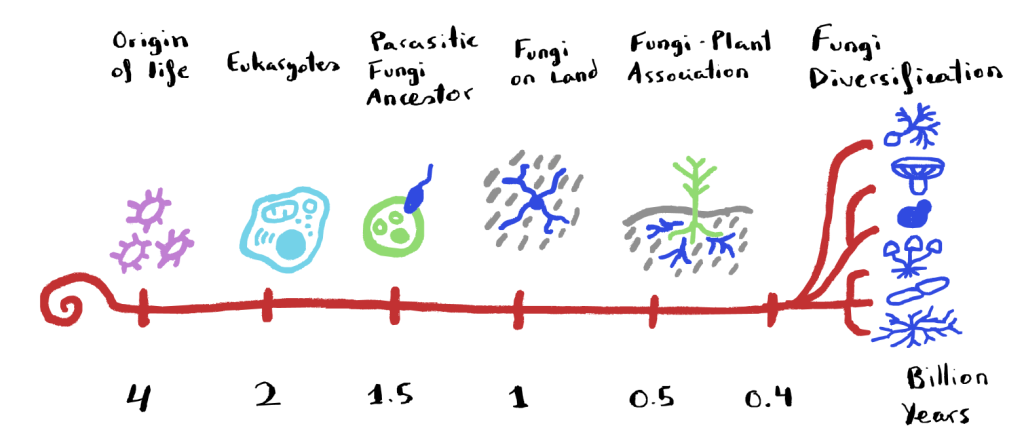
Yeasts evolved independently from different fungal lineages throughout natural history. These events show features of convergent evolution, with all yeasts showing high-speed growth and a reduction in the complexity of their secondary metabolism. It has been hypothesized that yeasts arise when fungi take over the ecological role of prokaryotes (e.g. bacteria) in environments that are challenging for these organisms, most especially those environments showing high osmotic stress and lack of water availability such as fruit juices or nectar.
Trying to link fruits and baker’s yeast
Linking baker’s yeast and fruit comes easily to us when we think about wine. The skin of grapes has been considered to be the natural habitat of the baker’s yeast for a long time, explaining why this yeast was selected through ancient wine-making practices. Plants with fruits appeared more than 125 million years ago, and some researchers claim that this led to the development of metabolic adaptations that differentiate baker’s yeast and some of its closest relatives from the rest of yeasts and fungi.
The metabolic adaptation in question is called the Crabtree Effect, and it consists of the ability to ferment sugar into alcohol even in the presence of oxygen. In other organisms, oxygen availability leads to respiration, which converts sugar molecules totally into CO2. This does not happen in baker’s yeast because of two mechanisms that evolved at different times. The first is an overflow metabolism, which means that more glucose is absorbed by the cell than the respiration machinery can cope with. The glucose leftover is then used by the fermentation machinery to produce alcohol. This mechanism has been estimated to have originated 125-150 million years ago. The second mechanism is the introduction of direct negative or repressive effects of sugar molecules in the respiration machinery. Researchers know that this second mechanism happened separately from the other one, after a genome duplication event that also allowed baker’s yeast to specialize in consuming alcohol as a carbon and energy source 100 million years ago.
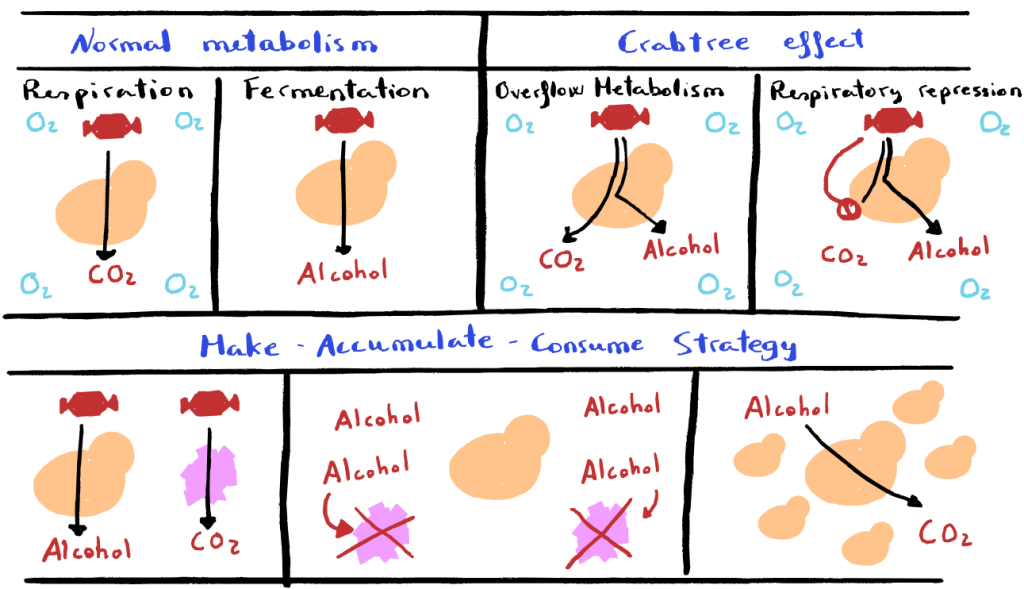
The rough match between the times of the emergence of plants with fruits and the evolution of Crabtree Effect systems have led some researchers to defend that baker’s yeast was selected in nature thanks to improved competitivity due to a make-accumulate-consume strategy. The idea behind this strategy is that baker’s yeast cells would be able to consume the energy-rich sugar molecules faster than other microorganisms (fermentation is faster than respiration). Alcohol production would have a double effect, firstly inhibiting the growth of other organisms more sensitive to its toxic effect, and secondly providing a carbon source that only baker’s yeast can use efficiently after all sugar is consumed. Some researchers have criticized this account, arguing that while this strategy might be true in human-made alcohol fermentation conditions, it does not necessarily reflect the natural behavior of the yeast.
Forget about the fruits: Neutral evolution hypothesis
There is an alternative to the story of baker’s yeast being selected to outcompete other organisms in sugar-rich fruit environments. Not every organism in nature is specialized to specific niches, but some have evolved tools to survive in a wide range of ecological habitats. Baker’s yeast could be such a generalist organism found in low quantities in nature, predominating only in the artificial conditions created by human-made fermentation systems.
Some arguments in favor of this hypothesis are that baker’s yeast is actually found in very small quantities in the skin of grapes and that it has also been found in a wide variety of habitats, from soil to plants and humans. Also, due to the association of baker’s yeast with fermentation, it is usual for fermenting conditions to be used as a method to isolate baker’s yeast strains from nature. This could introduce a bias in which only strains good at fermentation are identified, while maybe in nature there is a diversity in the fermentation capacity of baker’s yeast cells, which would undermine the idea that they have been selected by natural environments for such an activity. This is supported by the fact that wine fermentation sometimes fails, indicating that other microorganisms can outperform baker’s yeasts in some cases.
If baker’s yeast is not a naturally specialized yeast in fermentation, then how did the Crabtree effect originate? An alternative to evolution through selection is neutral evolution, which based more on the basal variability for which selection becomes important later. Without selective pressure, organisms can develop new traits as long as they do not lead to disadvantages. There does not need to be a connection between plants developing fruits and baker’s yeast developing Crabtree mechanisms, it could just have happened by chance. Neutral genetic drift is definitely a force in nature, but baker’s yeast accumulating two mechanisms for the Crabtree effect would seem like too much of a coincidence if only chance is involved.
In search of the birthplace of baker’s yeast
Even if we consider that baker’s yeast is a generalist with no specific niche, that does not mean it lived in all habitats across the world from the beginning. Niche is an ecological term, not a geographical one. During the last few years, there have been many wild strains of baker’s yeast isolated from around the world. By comparing their DNA sequences, a genealogical tree can be created to find out where baker’s yeast comes from, whether all industrial strains originate from the same populations, or whether there were different domestication events. Recent studies have revealed that Far East Asia is the likely place of origin for baker’s yeast and that all industrial strains are related to this original population.
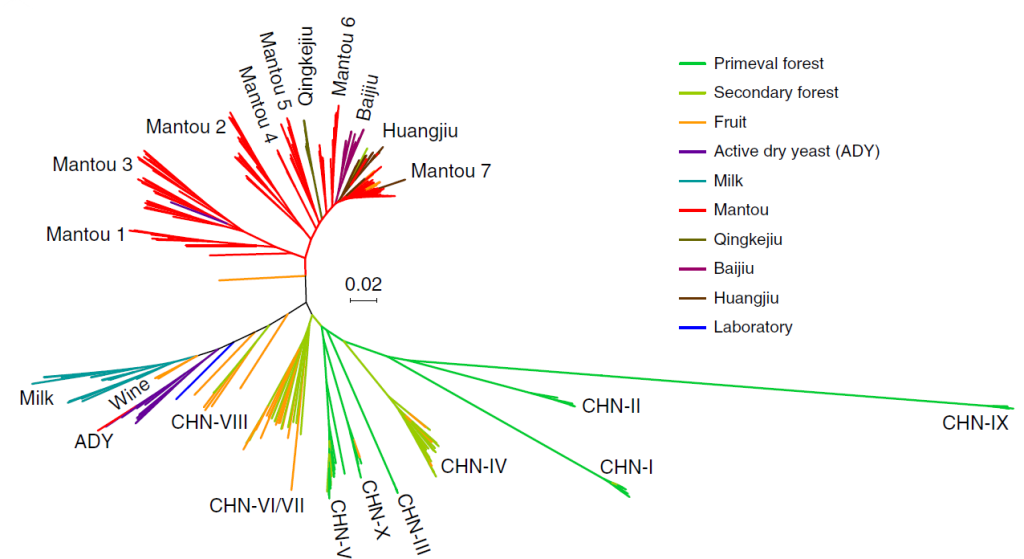
The evidence behind such a claim comes from wild strains isolated from primeval forests in China that are free from human contamination. What is more important about these wild populations is that they are more genetically divergent among themselves than all the other wild strains found across the world. This indicates that a small population of baker’s yeast from these Chinese forests was the one that spread across the world, most likely due to human action. In the same study, they also observed that yeast strains used for Chinese alcoholic drinks are related to yeast strains used in European wine and beer production, providing evidence of a single origin for the domesticated baker’s yeast.
Conclusion written by AI
The natural history of baker’s yeast reveals a far more complex and ancient story than its modern role in bread and wine might suggest. Evolving from early fungi that first emerged in aquatic environments, yeast adapted over time to occupy diverse ecological roles, from parasites to decomposers and, eventually, partners in fermentation. While some theories argue that yeast evolved specialized traits like the Crabtree Effect to dominate sugar-rich niches such as fruit, others suggest these traits may have arisen without direct selective pressure. Regardless of how these features developed, genetic evidence points to East Asia as the birthplace of baker’s yeast, with human activity later spreading and shaping its modern forms. Far from being a simple tool of fermentation, baker’s yeast is a remarkable example of evolutionary flexibility, shaped by both nature and culture.
Sources
- Article on the evolution of fungi: Naranjo-Ortiz, M. A., & Gabaldón, T. (2019). Fungal evolution: Major ecological adaptations and evolutionary transitions. Biological Reviews, 94(4), 1443-1476. https://doi.org/10.1111/brv.12510
- Article on the evolution of wine, defending the make-accumulate-consume strategy: Souhir Marsit, Sylvie Dequin, Diversity and adaptive evolution of Saccharomyces wine yeast: a review, FEMS Yeast Research, Volume 15, Issue 7, November 2015, fov067, https://doi.org/10.1093/femsyr/fov067
- Article on the ecological niche of baker’s yeast, defending the neutral evolution path: Matthew R. Goddard, Duncan Greig, Saccharomyces cerevisiae: a nomadic yeast with no niche?, FEMS Yeast Research, Volume 15, Issue 3, May 2015, fov009, https://doi.org/10.1093/femsyr/fov009
- Article on the natural origin of baker’s yeast in East Asia: Duan, SF., Han, PJ., Wang, QM. et al. The origin and adaptive evolution of domesticated populations of yeast from Far East Asia. Nat Commun 9, 2690 (2018). https://doi.org/10.1038/s41467-018-05106-7
 English
 Spanish