
The ability of yeasts to remain dormant for an indefinite period of time under the right conditions has allowed history enthusiasts to recreate fermented products from ancient times. Seamus Blackley, one of the Xbox inventors, produced bread using yeasts that had been dormant for 5300 years. He had the resources and connections to make this happen, but it is clear that a lot of people would find working with these ancient yeasts, or eating their products, a way to connect with ancient societies that have shaped the way we live today. In the same year, a team of scientists from Israel published a study in which they isolated yeasts from ancient vessels ranging from 3100 to 500 BCE. They studied them and determined which ones were likely to have been used to make beer. This article will explain how they did it.
Isolating yeasts from ancient vessels
The yeast cells are preserved thanks to the dry conditions in which these fragments were conserved. To bring them back to life, the fragments were introduced into a broth that contains all the nutrients needed for the yeast to grow and thrive, as well as the water needed to rehydrate the cells. After this, a portion of the broth was inoculated on solid growth substrate. Antibiotics were added here to make sure that any bacteria were killed, and any growth observed was due to the yeasts. When growing on a solid surface, yeast cells will remain close to each other when reproducing, and over time they produce a number of cells that is visible to the naked eye and it is called a colony.
The tested ceramic vessels came from four different archaeological sites. Egyptian vessels from 3100 BCE were collected from two different sites, one in the desert and the other one in Tel-Aviv. They also collected Persian vessels dating back to 500 BCE, as well as Philistine vessels dating back to 850 BCE. The Philistines were an ancient people originating from modern Greece who settled in the Mediterranean Levant during the Iron Age. The vessels were thought to have contained beer or fermented drinks due to their shape being similar to the ones known to have been used for these purposes. In total 21 fragments were analyzed, and from these six led to the formation of yeast colonies in the last step of the isolation process.
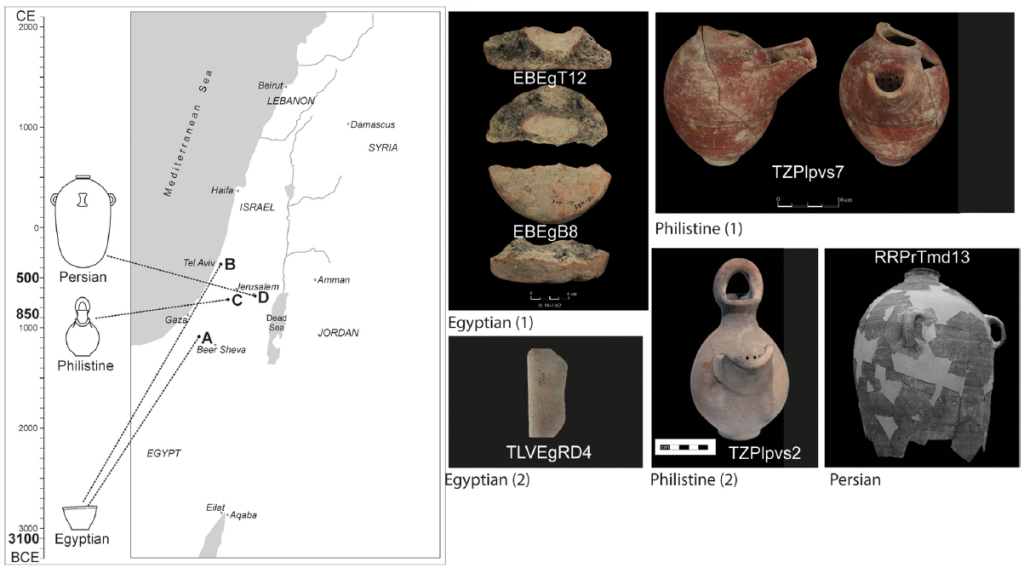
There is always the possibility that the yeasts obtained were not actually associated with beer, but rather were yeasts present at the archaeological sites for other reasons. To make sure the strains were associated with beer, the researchers tried to isolate yeasts from a total of 110 samples including fragments of vessels not associated with beer, and sediments and stones gathered from the surroundings of the archaeological sites. Out of all these samples, only two yeast samples were obtained. One of them was Candida albicans, the white yeast, but due to its pathogenic nature was considered a contamination derived from the humans involved in the study. The other one was a yeast that could not be identified. The low number of yeasts isolated from these samples (negative controls) gave the researchers confidence to state that the six yeasts isolated from the beer vessels are indeed associated with beer.
Identifying yeast species through DNA sequencing
The next step is to identify the species to which the six yeast samples belong. That way the researchers can know if they are the same species as the yeasts used today to make beer. Identifying the species of yeasts is not as easy as animals and plants, where it is done mainly by identifying physical characteristics, since most yeast cells are quite similar under the microscope. Although when growing in solid growth substrate they can form colonies of different colors and textures depending on the yeast species, these differences are not strong or varied enough to allow for species identification.
The best way to identify yeast species is by sequencing their DNA. In this case, the researchers sequenced the full genome of the obtained yeasts. They used more than one genetic feature to make sure that the right species was assigned to the studied yeasts. The most important one was the Large Subunit of the Ribosomal RNA (LSU rRNA). This is a crucial part of the genome that encodes a component of the ribosome, the cellular machine responsible for translating genetic information into proteins. Because of its importance, it mutates very slowly. This is because almost every mutation will negatively affect a very important process for the cell, so natural selection will work against mutations. Because of this, every yeast species has a specific LSU rRNA sequence. By comparing the LSU rRNA sequences of known yeasts to the LSU rRNA sequences of the yeasts found in the ancient vessels, their species could be identified, or at least the closest ones they are related to:
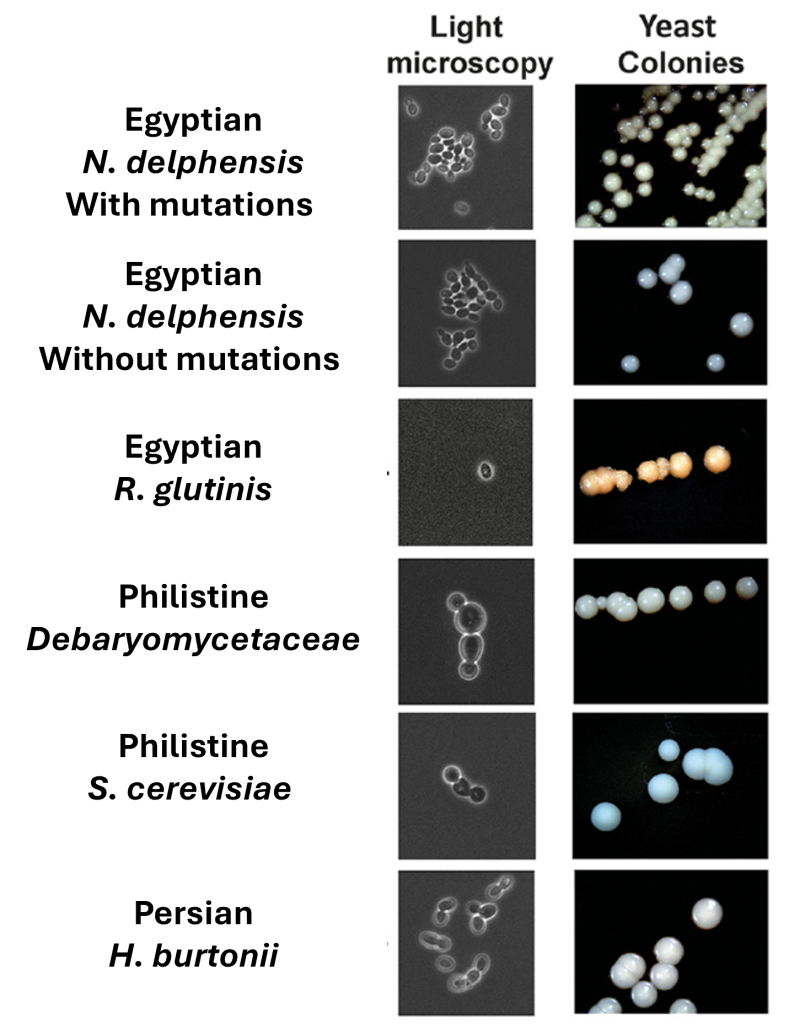
- The yeasts isolated from the Egyptian jars in the desert were Nakaseomyces delphensis. This yeast has been found previously in dry figs, so it is possible that figs had been added to the drink contained in these vessels. Actually, there were two different strains (subspecies) so the researchers studied their genome and compared their differences. They noticed that one of them contained mutations that had been reported before to be associated with beer production. This was confirmed in later experiments, because this strain and not the other one was able to produce alcoholic beer.
- The yeast isolated from the Egyptian jar in Tel Aviv was Rhodotorula glutinis, a red yeast. These yeasts produce red colonies because they accumulate carotenoids, chemicals that give red-orange color to other organisms such as carrots or tomatoes. These red yeasts cannot produce beer, but they have been observed before to contaminate local Nigerian drinks. Therefore, it is possible that the studied jar had also been contaminated with this yeast back in the Ancient Egypt.
- One of the yeasts isolated from the Philistine jar was an unknown species from the Debaryomycetaceae family. Some yeasts from this family have been found in traditional African beers brewed with sorghum.
- The other yeast isolated from the Philistine jar was Saccharomyces cerevisiae, the baker’s yeast. This is the main brewing yeast nowadays, so it was a clear indication of successful brewing activity. Since there is so much research done on this yeast and so many strains identified, the researchers looked closely at the closest known strains to the isolated baker’s yeast. It was found to be genealogically close to strain Wine007, a strain used to make wine as its name indicates.
- The yeast found in the Persian jar was identified as Hyphopichia burtonii, which has been isolated previously from tej, an Ethiopian mead.
Studying the beer produced by the ancient yeasts
Once the yeasts had been identified, the researchers tested if they could be used to produce beer. The first step was to make sure that they can grow in beer wort, the juice obtained after the treatment of the grains. They were compared to a modern strain of S. cerevisiae normally used to brew beer (called SafAle S.04). Unsurprisingly, they observed that the S. cerevisiae strain isolated from the Philistine jar was the one that showed the most similar growth pattern. H. burtonii from the Persian jar was the one that came in second, but all the others seemed to grow worse, either because they reproduced more slowly or because they stopped growing at some point.
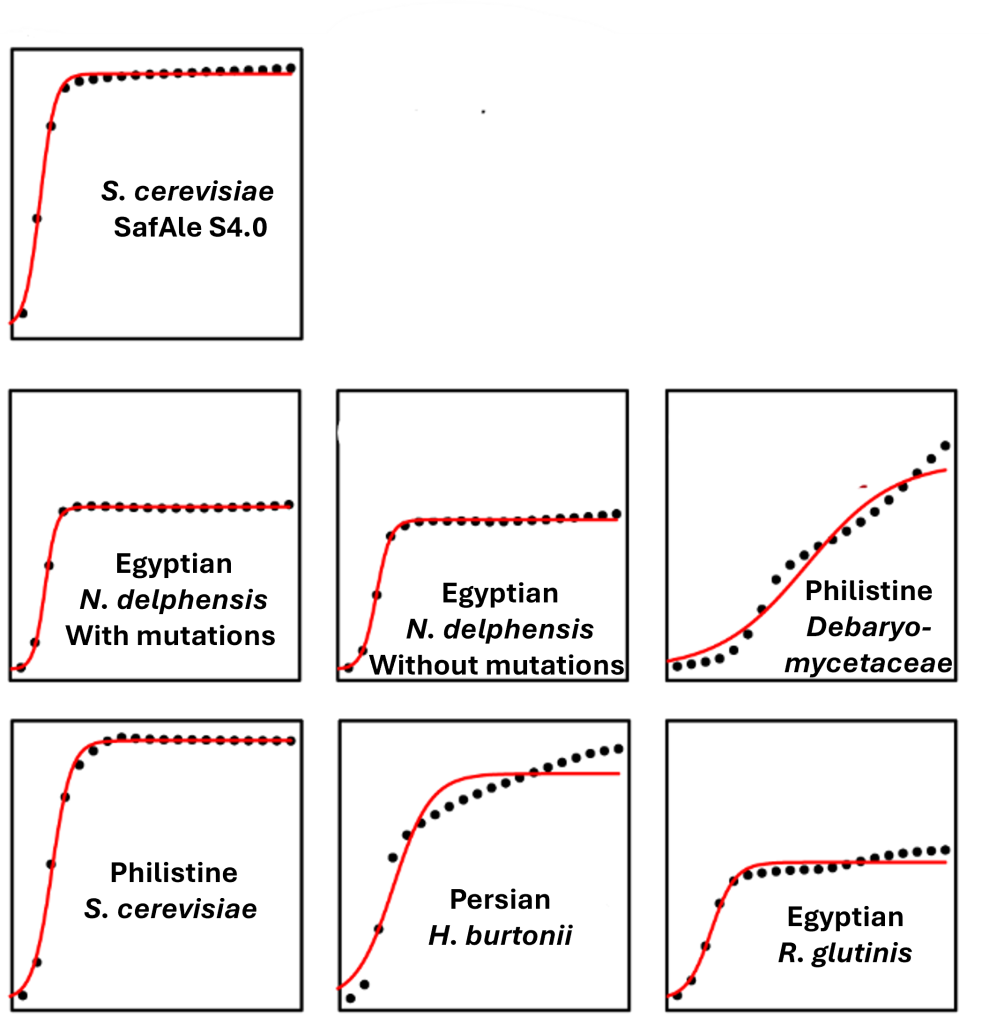
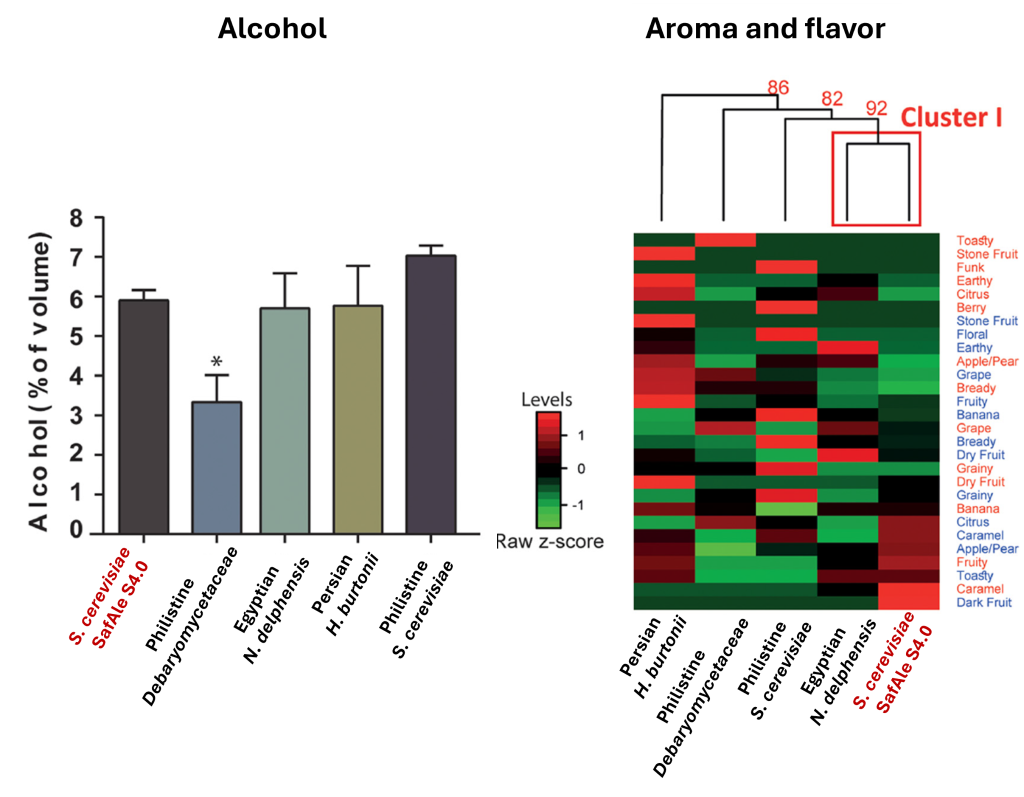
After all this, the researchers were prepared to make beer using these ancient yeasts and to study the results. For this, R. glutinis was not used, because it is known to be a pathogenic yeast. From the rest, all of them led to a fermented beverage. However, one of the strains from N. delphensis produced a drink with a strong spoiled aroma and flavors, so it was discarded from further analysis. The four remaining yeasts successfully produced drinkable alcoholic beverages. They all produced similar levels of alcohol (around 6%, which is similar to usual modern commercial beers), with the exception of the yeast from the Debaryomycetaceae family, which produced around 3% of alcohol and a beer whose taste was a little off.
The researchers went beyond producing drinkable beers and gave them to a group of professional beer tasters, who scored them in different tastes and aromas. They compared them to a beer produced with the standard brewing strain S. cerevisiae SafAle S.04. Surprisingly, the most similar beer was not that one produced from the ancient S. cerevisiae strain from the Philistine jar, but the one produced by the N. delphensis strain from Ancient Egyptian jars. This is the strain that had the mutations associated to beer production, showing that these mutations are more important in determining a yeast’s brewing potential than the species it belongs to.
Conclusion
This research has shown that it is possible to isolate yeasts from ancient vessels, and that these yeasts can produce high-quality beer. This is very interesting on its own, but the identity of the yeasts provides much more interesting information. Despite the small sample size, the diversity of organisms found is impressive. It is true that some of these organisms might be contaminants, but there is a clear indication that brewing in ancient times was not monopolized by S. cerevisiae as it is today. The fact that S. cerevisiae became the dominant yeast today might be due to the importance of grape wine, since this yeast inhabits the skin of grapes. This research found that N. delphensis, a yeast that grows on figs, had already accumulated mutations that allowed it to create good quality beer. We know that in ancient times there were wines being produced from other non-grape sources, such as dates and pomegranates, but also figs. In a parallel universe where fig wine was the standard wine consumed through history, N. delphensis might have become our baker’s yeast.
Sources
The main source for this post has been the article “Isolation and Characterization of Live Yeast Cells from Ancient
Vessels as a Tool in Bio-Archaeology” by Tzemach Aouizerat et al. published in 2019 in mBio. You can access it here. All figures in the post have been obtained and adapted from their article.
Also, the news article on Seamus Blackey producing bread from ancient yeasts can be found here.
 English
 Spanish