
The search for archaeological remains of fermentation aims to find the first culture to control fermentation processes. Whether this or that culture achieved this or that fermentation milestone first will always be difficult to prove, but what is definitely true is that alcohol fermentation has originated independently across different societies. Anthropological and archaeological research show that non-agrarian societies can develop fermentation techniques that include alcohol production, but also go beyond that.
The baker’s yeast has spread throughout the world as an agent of fermentation, thanks to its ability to produce alcohol. However, early humans could not possibly select yeasts to perform fermentation processes, and these were by necessity open systems, in which a wide diversity of microorganisms would take part. During individual fermentations and across multiple fermentations in the same pot or hole, some microorganisms would begin to outcompete others.

Yeasts can take over thanks to their alcohol production, which they can tolerate but results in toxicity to other microorganisms. Another type of microbe closely associated with food fermentation is lactic acid bacteria, found in products such as yoghurt. Lactic acid bacteria produce lactic acid from sugars in anaerobic conditions, and this lactic acid leads to a decrease in the pH of the medium, which hampers the growth of other microorganisms.
Rather than being a “recent” human technology, some researchers are putting forward the idea that yeasts and lactic acid bacteria have been involved with human food since the beginning, and we would not have become human without them. Three questions can be asked around this: Was it possible for early hominids to control fermentation? Why did it happen? What consequences did it have?
Fermentation consumption in primates
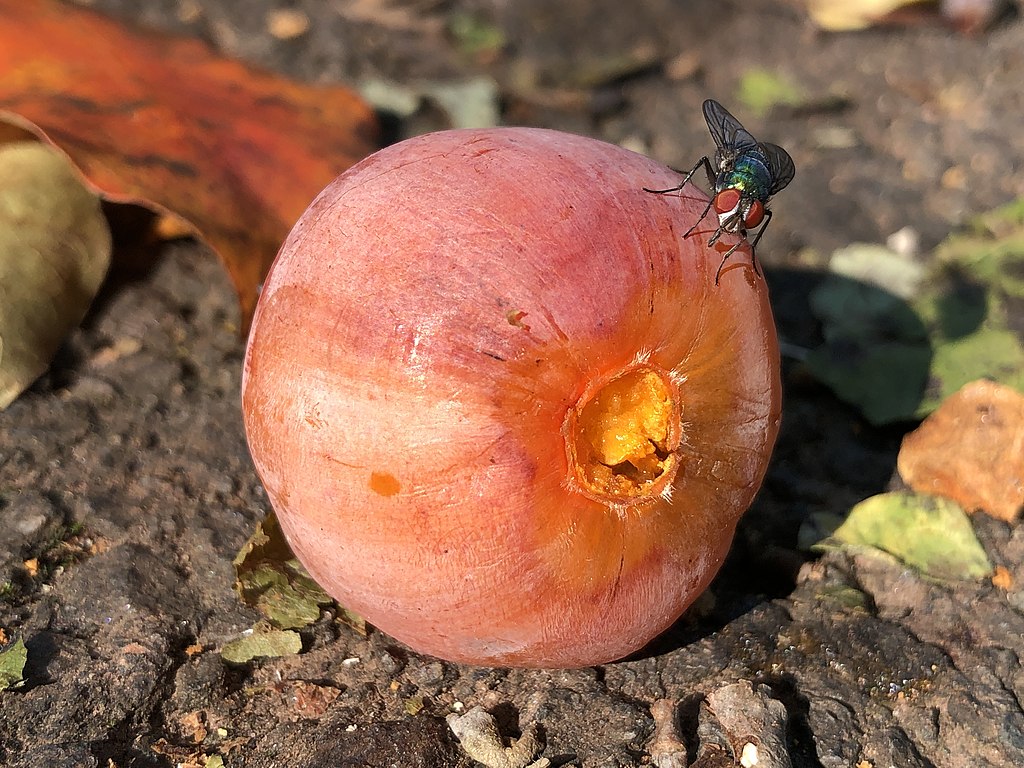
Yeasts and other microbes used in food fermentation today are found in nature, and in the right conditions, they will spontaneously produce fermented food. This happens sometimes after fruits fall to the ground, and there are plenty of reports of animals eating these. While in most cases this consumption is accidental, there is a famous theory called the “Drunken Monkey Hypothesis” that claims that some primates, including human ancestors, did seek fermented products.
The “Drunken Monkey Hypothesis” defends that human attraction to alcoholic drinks is a remnant of a natural attraction to alcohol, motivated by its higher caloric content. This hypothesis has received a lot of criticism, but independently of it, there are reports of primates seeking fermented fruits, and genetic evidence shows that early primates regularly consumed fermented food.
Genetic evidence
If we just look at the genetic level, consumption of fermented foods started around 10 million years ago. This is before humans appeared as a species, and before our lineage got separated from other apes. There are two mutations that are shared among large apes.
First, we have a variant (ADH4) of the enzyme alcohol dehydrogenase that is 40 times more efficient than in other animals. Alcohol dehydrogenase is important for metabolizing ethanol and reducing its toxic effects on the body, so it appears that apes became more adapted to alcohol consumption than other animals at some point.
The second mutation is in a gene from a family of receptors that regulate immune function and energy homeostasis (HCAR gene family). The new gene that appeared in apes seems to be especially responsive to molecules produced by lactic acid bacteria present in fermented foods.
These two mutations strongly indicate that apes were exposed to fermented foods both by yeasts and lactic acid bacteria. However, this does not mean that apes “did” fermentation. These mutations most likely were just an adaptation to a change in diet which included more fruits harvested from the ground. So, genetic changes cannot support the idea that early hominids could control fermentation, but we can look at current primate behavior to support this idea.
Behavioral studies
Some populations of primates seem to have an idea about fermentation, since they have been observed dropping perfectly fine, edible, and ripe fruits on the ground. The interesting part is that after a while, once the fruit has had time to ferment, they return to eat it. These primates include capuchins, spider monkeys, and brown lemurs. What’s more, some capuchins have been observed to bite into the fruit before they drop it, an action that accelerates fermentation and can be linked to the traditional production of chicha in South America.

The behavior of these monkeys is indeed striking, but although it leads to fermentation, it cannot be said that these monkeys are controlling fermentation processes. Nevertheless, these behaviors and the general knowledge of primate intelligence suggest that it was possible for early hominids to generate social practices that eventually would lead to control of food fermentation. The question here is: What moved early humans to these practices?
Fermentation and nutrition in early hominids
An image people often have about human evolution is the transition from a life on the trees to one on the ground, with early humans little by little adapting to walk on two legs. Bipedalism was not the only adaptation to this new environment, and it has been suggested that fermentation played a big role, too. These hominids living on the ground still had access to foodstuffs, such as fallen fruits or tubers hidden in the soil.
The problem is that some fruits and most tubers are hard to digest because either they contain toxins, have too much fiber, or hard too hard to chew. The fermentation of both fruits and tubers would have fixed these issues, since yeast and bacteria can breakdown hard plant fibers and can convert some toxic substances into innocuous ones. While the expansion of dietary options is a good explanation for the beginning of controlled fermentation, it would be nice to have some evidence that this happened.
In fact, evidence has been put forward, and it relates to the size of the colon in humans compared to other primates. The colon is important because it is where most of the human microbiota is hosted. These microorganisms are essential for good digestive health, to provide essential vitamins, and to regulate the immune system in general. Besides this, animals usually make use of bacteria and yeasts in their digestive system to access nutrients from indigestible parts of plants, like fibers.
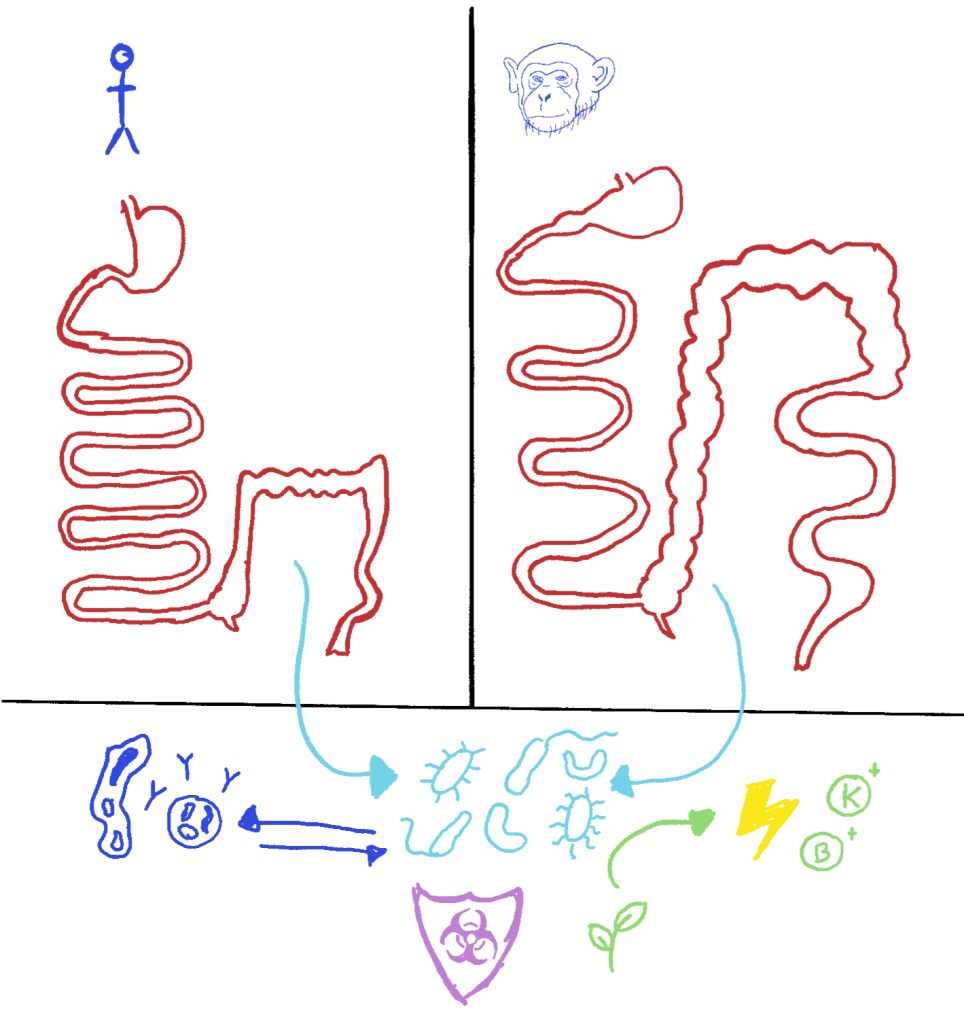
The human colon is much shorter than the one found in other primates. This has been previously explained by a meat-based diet that would not need to digest plant material. But a pure meat diet seems unlikely to early hominids, and more before the control of fire. Another explanation for a shorter colon is that the fermentation that would happen in the colon started to happen before the food was eaten. An archaeological observation that supports this theory is that early hominids appear to have transported food resources to specific locations instead of eating them on the spot.
Fermentation and the brain
At this point, we know that there are strong arguments supporting that early hominids could have developed fermentation practices, and that these would have been selected by evolution because of their improvement in nutrition. The next thing to look into is the significance of fermentation in human evolution, and more particularly on the increase in brain size. The increase in brain size for early humans is seen as the anatomical milestone to develop the advanced intelligence that ended up with humans conquering all sorts of regions, climates, and ecosystems.
Brain expansion and cooking
The importance of brain expansion is well established, and a hypothesis has been put forward for a long time relating diet to brain size. The problem with a bigger brain is that it is very expensive in terms of energy. Even if we were to imagine early hominids arriving at a paradise where plenty of food is available to provide the energy for brain expansion, such conditions would not create an evolutionary challenge to increase brain size. Thus, it has been suggested that rather than the environment, it was a change in the dietary habits of early hominids that helped to provide the necessary energy for brain expansion.
We have already mentioned that meat consumption has been proposed as a diet change in early hominids. This would not have been the result of hunting, which only developed later, but of scavenging dead corpses. However, this would provide a very limited amount of energy, so it has been proposed that early hominids would drive away predators after they had killed prey. Nevertheless, it seems unlikely that early hominids could have faced large predators before the development of weapons and social communication.
Another common diet change mentioned in the brain expansion hypothesis is the development of cooking. The use of fire makes food more digestible, both meat-based and plant-based. However, this option is even more unlikely because the control of fire would have required advanced cognitive skills only available after the brain had already expanded.
Against these options, external fermentation of fruits and tubers provides a suitable alternative. Not only would this practice increase nutrient availability and conservation of foods for scarcity periods, but as explained before, external fermentation also explains the reduction in gut size. This is very important because the guts are also a very energy-demanding part of the body, so reducing the colon would liberate energy for brain expansion. Thus, it seems likely that yeasts and bacteria are partly responsible for early hominids expanding their brain, and that we would not be here without them.

Conclusion written by me
There were many factors that have allowed humans to exist, from bipedalism and the liberation of hands to use weapons to the development of spoken language for social communication. However, fermentation has often been overlooked as either a minor player in animal diet, or as a technology characteristic of advanced civilizations. However, there are strong arguments to defend that fermentation was essential for human evolution.
Controlling fermentation requires very limited cognitive skills, and similar activities have been observed in other primates, which makes it very likely that early hominids could have developed slightly more advanced techniques. Fermentation of hard-to-digest fruits and tubers would liberate nutrients and increase dietary options for early hominids, which would explain their evolutionary success. Transferring fermentation from the colon to outside allowed for the reduction of the size of the guts, liberating energy for the expansion of the brain and therefore driving cognitive evolution.
While we may have only discovered yeasts and bacteria recently, they have always been there, and their importance to human nutrition and biology goes beyond just alcohol production or cheese making.
Sources
- Article on primate and early hominid fermentation, and its impact on nutrition: Katherine R. Amato, Elizabeth K. Mallott, Paula D’Almeida Maia, and Maria Luisa Savo Sardaro. Predigestion as an Evolutionary Impetus for Human Use of Fermented Food. Current Anthropology, Volume 62, Number S24 (2021)
- Article on brain expansion and fermentation: Bryant, K.L., Hansen, C. & Hecht, E.E. Fermentation technology as a driver of human brain expansion. Commun Biol 6, 1190 (2023)
- Article on an evolutionary perspective on the genetics of alcohol consumption: Clites BL, Hofmann HA, Pierce JT. The Promise of an Evolutionary Perspective of Alcohol Consumption. Neuroscience Insights. 2023;18.
 English
 Spanish