
The guy from pasteurization
Louis Pasteur, born in 1822, in Dole, France, was a pioneering chemist and microbiologist whose work has had a profound impact on science and medicine. Raised in a modest family, Pasteur showed an early aptitude for science and pursued his education diligently, eventually earning a doctorate in chemistry from the École Normale Supérieure in Paris. Pasteur is best known for developing the process of pasteurization, a method based on heating liquids such as milk and wine to eliminate harmful microorganisms and prevent spoilage, which remains a critical practice in food safety today.
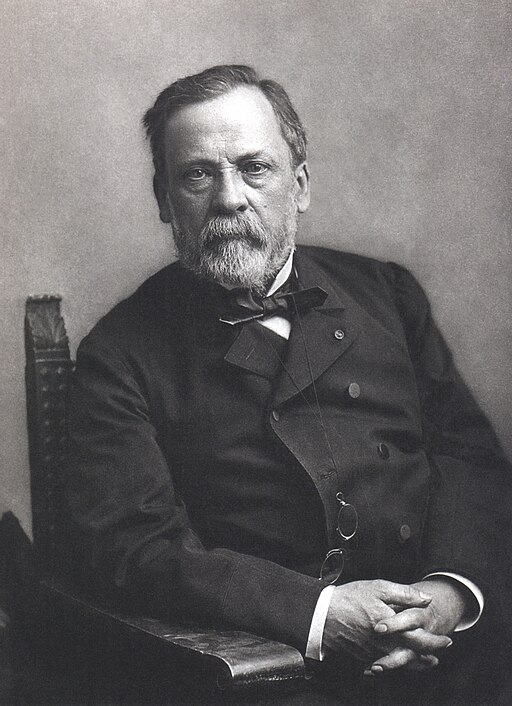
Pasteur’s work in germ theory fundamentally changed the medical community’s approach to disease causation, proving that many illnesses were caused by microscopic organisms. This breakthrough led to significant advances in medical hygiene and public health practices, drastically reducing the spread of infections. Additionally, Pasteur’s innovative research paved the way for the development of vaccines, including those for rabies and anthrax, which saved countless lives and established principles still used in modern immunology. His dedication to scientific inquiry and his numerous achievements have cemented Louis Pasteur’s legacy as one of the most influential and respected scientists in history.
Going from optics to microbiology
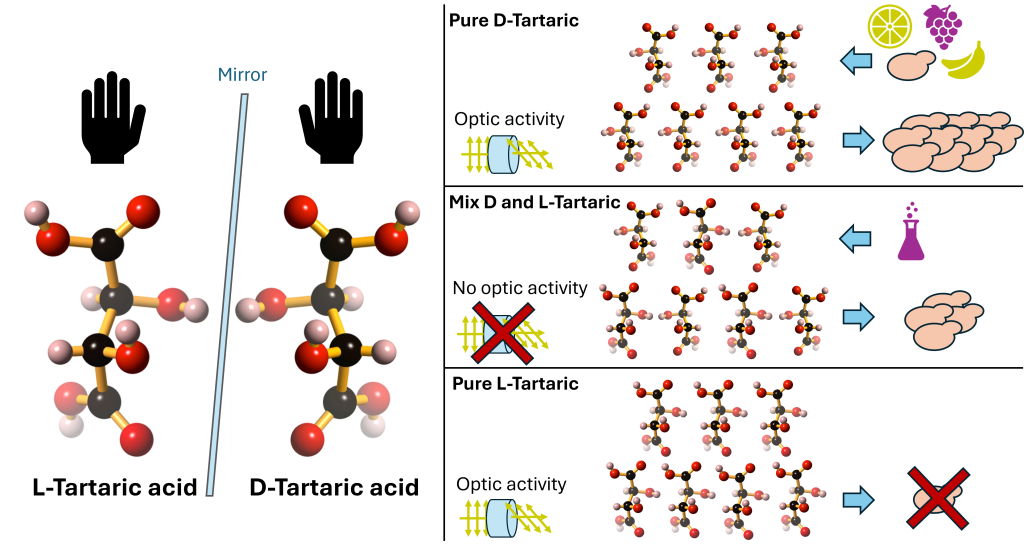
At the time when Pasteur started doing research, the biological nature of fermentation had been proved by different experiments and accepted by most scientists, but there was still some resistance. Before 1875, Pasteur established the role of yeast in fermentation and its physiological nature, as well as showing the effect of oxygen in this process. Pasteur’s work ultimately led to unanimity in the scientific community about fermentation being a biological process. However, Pasteur career did not start in biology. He began studying optical activity, which is a feature of certain substances that allows them to interact with light, particularly by changing the orientation of light waves. Pasteur showed that this activity was related to the chemical structure of the molecules, and more specifically, the asymmetry in their structure (enantiomorphism). He quickly observed that all molecules showing optical activity were only obtained from living organisms, hinting that these might have some special power that allowed them to synthesize asymmetrical molecules.
Pasteur started to work with fermentation processes when he became a Chemistry Professor in a French region where the fermentation of beet sugar for alcohol production had become a major industry. In 1855 he showed that a product of a fermentation process showed optical activity, which for him was a clear indication that fermentation was a process associated to life. Not only did he show that fermentation could produce certain asymmetric molecules, but he also showed that some fermentation processes could only use as starting material certain asymmetric arrangements of a molecule. Certainly, the asymmetry of molecules was very linked to living processes.
His most important work on yeast was published in 1860 and it dealt with the effect of oxygen on yeast fermentation. Pasteur set up an experiment in which the yeast would grow in two vessels containing the same amount of sugar, but one of them had its opening blocked by mercury, blocking the entry of oxygen coming from the air. When growing in the presence of oxygen, the yeasts grew more but produced less alcohol. Pasteur described that even if the ability to ferment sugar to alcohol seemed reduced in these yeasts, the capacity for fermentation remained intact, and it was reactivated to their full capacity after growing these yeasts in a recipient without oxygen. Based on this work, he called organisms able to grow without oxygen (like baker’s yeast) “anaerobic”, while those that needed oxygen to grow would be known as “aerobic”.

Pasteur’s work was exclusively focused on the physiological activity of the yeasts, and he did not care about taxonomic distinctions. He noticed that there was no clear correlation between the shape of the yeast under the microscope and the physiological activities it showed. Nevertheless, other researchers started exploring the biodiversity of yeasts, isolating them from a variety of sources. For example, in 1853, the French biologist Charles-Philippe Robin isolated a yeast from the mouth of a patient suffering from thrush. He noticed these yeasts formed very white colonies, so he called the species Oidium albicans, from the Greek “albus” meaning white. Today, this yeast is called Candida albicans, and thrush is also commonly known as candidiasis, one of the most common infections in humans caused by yeasts.
Enter “Enzyme”: the end of the war between biologists and chemists
Fermentation was now proven to be a process that required living cells, but there were related processes to fermentation that did not require living cells. One of these processes was the “inversion of sugar”, which means breaking the sucrose (AKA common sugar) molecules into their components: glucose and fructose. In 1860, Pasteur made a hypothesis that during fermentation, the yeast secreted acid molecules that lead to the breakdown of the sucrose molecules. However, there was already research done proving that yeast material could break down sucrose even after being killed, and that the cause of this reaction (AKA the active principle) was secreted by the yeast.
Pierre Eugène Marcellin Berthelot, a prominent researcher in organic chemistry, published a research paper in which described how he isolated from yeast the active principle that caused the breaking down or inversion of sucrose, which he called “glucoside ferment” (and what we call nowadays invertase). Furthermore, he made experiments that showed that this “glucoside ferment” carried out its activity even in alkaline conditions, refuting the hypothesis of Pasteur. Berthelot compared the activity of this “ferment” to other substances purified from other organisms that performed specific chemical activities, such as the pepsin secreted by animal stomachs which can degrade proteins. Pasteur quickly replied that he did not care about the inversion of sucrose, and that he was only focused on what happened after, which for him was the real fermentation, the one that produced alcohol. However, the word “ferment” started to gain acceptance in the scientific community and even in 1876 Pasteur refers to the invertase secreted by the yeast as “ferment”.
During this period there was an improvement on the understanding of the active principles behind chemical reactions happening in biological processes. In 1878, a German scientist called Wilhelm Traube published an article which summarized the knowledge at that time. He describes that these “ferments” are known to be related to “albuminous bodies” (in modern words, they were known to be proteins), and that even though none of them had been purified, it was accepted that their specific chemical activities were a result of their chemical compositions and their affinities with specific chemical compounds. He also defended that these ferments were not the result of a vital activity, but that they were the cause of chemical processes.
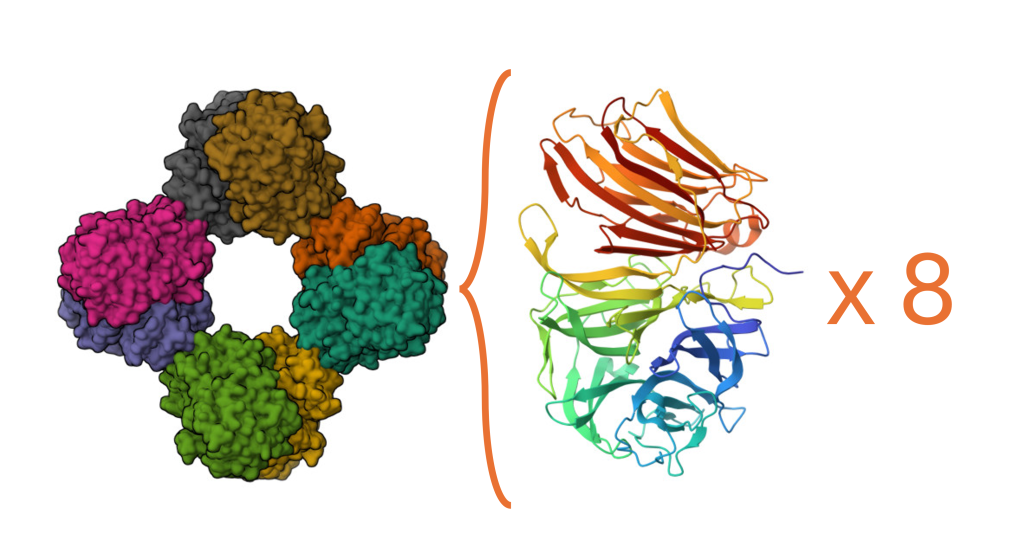
The increasing use of the word “ferment” for two different things, one which seemed of biological nature (the fermentation studied by Pasteur), and the other one which seemed of chemical nature (the “ferments” isolated by Berthelot), led to confusion in the scientific community. In 1878, this situation was fixed by another German scientist called Wilhelm Kühne by introducing a new term that would come to dominate biology: enzyme. This word, meaning in Greek “inside yeast”, was vaguely defined by Kühne as something inside the cells that has a specific chemical activity. He also defended that the enzymes studied in yeasts were not that different from those studied in higher organisms such as plants and animals. Even though this word gained popularity, and it greatly simplified the scientific discussion about the causes of biological process, questions around the role on enzymes in biological activity of cells (which we would now call metabolism) remained unanswered for years to come.
Source
This post is a part of a series summarizing the work on the history of yeast research done by James A. Barnett, this particular post is based on the first article of the series: A history of research on yeasts 2: Louis Pasteur and his contemporaries, 1850–1880
 English
 Spanish