

Fermentation now and then
Humanity has used yeast and other microorganisms to produce different kinds of food or beverages since prehistoric times. A word that comes to mind when thinking about yeasts and food is fermentation, but this word is hard to define in a specific way. Fermentation can be a way to use yeast or other microorganisms to obtain food products, such as bread or kimchi, or drinks, such as beer, sake or kombucha. Fermentation can also be understood as the controlled growth of microorganisms, either to obtain this microorganism (e.g. growing fungi as protein source), or because this microorganism is producing a valuable product (e.g. insulin production by transgenic bacteria). Finally, fermentation is also the name given to those metabolic (chemical) reactions happening inside any living organisms that is used to produce energy without the complete oxidation of the molecule that is used as source of energy. For example, during fermentation sugar cannot be converted completely to CO2, so another “waste” product is formed, such as alcohol or lactic acid. While “fermentation” refers to different things, microorganisms and their activity are always at the center of it.
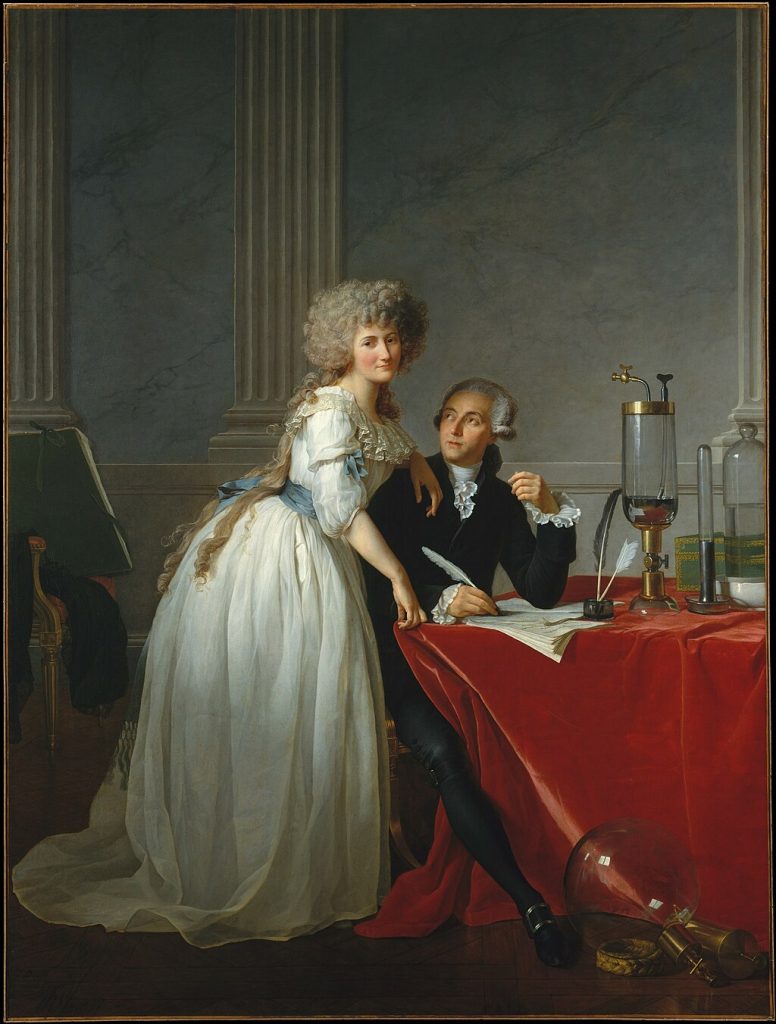
Antoine Laurent Lavoisier (1743–1794) and Marie Anne Lavoisier (Marie Anne Pierrette Paulze, 1758–1836) – painting by Jacques Louis David, CC0, via Wikimedia Commons
But this relation between fermentation and microorganisms had to be discovered. Since humans started baking bread or brewing alcoholic beverages, they have been aware of fermentation as a process, even if they did not know what caused it. The same goes with yeast, which was associated mainly with the sediment formed in the end of the beer brewing process. Of course, both yeast and fermentation were related to each other, and in the English dictionary of 1755 written by Samuel Johnson, yeast was defined as “the ferment put into drink to make it work; and into bread, to lighten and swell it.”
Because scientists were unaware of the biological nature of this process, it was considered mainly a chemical process. One of the first scientific studies of fermentation was carried out by the famous Marie-Anne and Antoine Lavoiser. They studied the elemental composition of the components involved in the fermentation process, including that of the yeast, to show that the fermentation could be studied as a precise and quantitative process which turned “grape must” into alcohol and carbonic acid (CO2 plus water).
Antoine Lavoiser was executed in the years after the French Revolution, but the topic of fermentation remained important to the French Republic, mainly due to the wine industry. One of the problems of the industry was that sometimes, the fermentation would go bad, leading to the production of vinegar or sulfuric disgusting flavours. We know now that these happen because other microorganisms outcompete the baker’s yeast, and end up producing other “waste” products different than alcohol, such as acetic acid in the case of vinegar. However, this was a mystery at the time, and the French Institute promised a large sum of money to whomever could crack the question of what was the active principle behind (good) fermentation, which would help avoid bad fermentations. No one discovered the solution soon enough to claim the prize, but this contest gave a push to research on fermentation.
Those weird little plants
The first person who thought about looking at beer through the microscope was M.J.B. Desmazières. He saw small globular organisms and gave them the name of Mycoderma cervisiae, since cervisiae is one of the latin words meaning “beer”, while mycoderma (“fungi skin” in latin) refers to mother of vinegar, a skin-like structure formed by organisms involved in vinegar production from alcoholic drinks. He did the same with wine, and was surprised to find similar organisms, and he called these ones Mycoderma vini, after the latin word for “wine”. Nevertheless, this was just a very descriptive work and he did not make the slightest link between these organisms, the observable yeast after brewing and the fermentation process. That happened 10 years later by no less than three researchers from different fields doing independent work.
Charles Cagniard-Latour was physicist and engineer that studied the observable yeast sediments under the microscope. He observed that they were living organisms, that due to their inert nature he considered to be part of the vegetable kingdom. He also noticed that they divided through budding, producing smaller cells that would separate from the mother cell when grown enough. He mentioned directly that they were the ones responsible for the fermentation leading the production of alcohol.
Friedrich Traugott Kützing was an algologist that published drawings and descriptions of yeasts under the microscope. He suggested that different organisms could produce different kind of fermentations. This would be confirmed a few years later by Louis Pasteur.

heated air to a solution of cane sugar mixed with beer yeast, the solution and yeast having been first heated to about 100°C.Illustration from Löffler (1887) obtained from James A. Barnett’s article (1998).
Theodor Schwann was a physiologist, and the most famous of these scientists, since he is the main responsible for the refutation of the theory of spontaneous generation. Until then, it was thought that fermentation was actually started by oxygen, but Schwann showed that this was not the case, since heated air was not enough to start the fermentation process, and therefore, it was another agent present in the air that was inactivated by heat. He also studied yeasts through a microscope, identified them as the agent causing fermentation and termed them “sugar fungus”, which was translated into Latin as Saccharomyces to describe this organism scientifically.
Chemistry defeated
The idea that yeasts were living organisms and the microscopic evidence was not welcomed by all, and several scientists defended the pure chemical nature of fermentation. Among these we find F. Wöhler and J. von Liebig, two university professors who wrote a satirical piece in a scientific journal in which they described yeasts as miniature distillation machines that would defecate alcohol and urinate CO2. Their resistance to accept the living nature of yeasts has to be understood from the perspective of the recent developments on organic chemistry, pioneered by Wöhler. He managed to synthesize urea, a molecule found so far only in living organisms, and showing that there was no special living force necessary to create living matter, that organisms were just formed by chemical components.
Anyway, they were eventually proven completely wrong when Mistsherlich and Helmotz observed that the yeasts were so big they could not pass through filters, and when Schlossberger studied their chemical composition, which was very similar to other organisms. In the defense of the chemical rebels, the fermentation was indeed a chemical process, even if it happens inside yeasts. But there was nothing they could do, yeasts are very much alive.
Timeline
Source
This post is a part of a series summarizing the work on the history of yeast research done by James A. Barnett, this particular post is based on the first article of the series: A history of research on yeasts 1: Work by chemists and biologists 1789–1850
 English
 Spanish